Placid Alternatives: 7 Image, Video and PDF APIs Compared (2026)
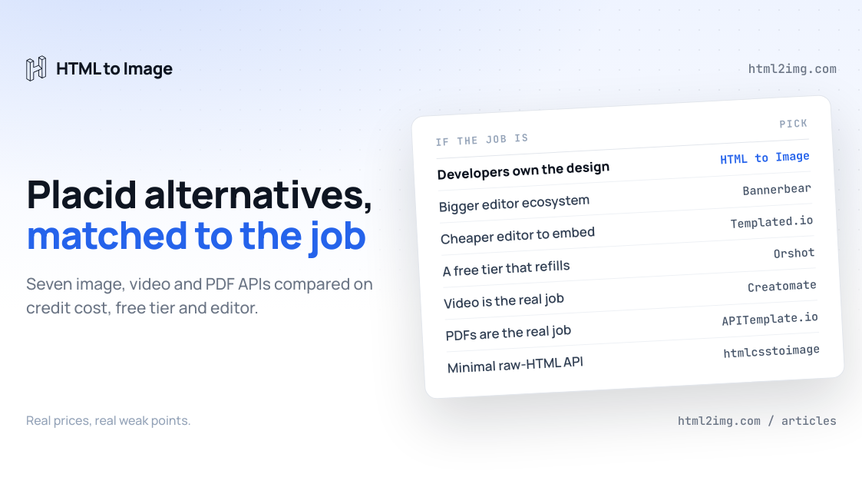
Placid is a well-made creative automation tool. You design a template in its editor, send data through the API, a Zapier step or an Airtable base, and get back an on-brand image, video or PDF. The entry plan is $19 a month, which looks cheap until you do the credit maths: those $19 buy 500 credits, an image costs one, every ten seconds of video costs ten and every PDF page costs two. That is 500 images, or 50 ten-second clips, or 250 pages a month, all drawn from the same pool.
That arithmetic, and a few plan gates behind it, is why "Placid alternatives" is a search people run. Below are seven services that cover the jobs Placid does, priced from their published rates, with a plain note on who each one suits.
Disclosure: we built HTML to Image, and it is first on this list. The other six are written the way we would want a competitor to write about us, with real prices and real weak points.
The quick comparison
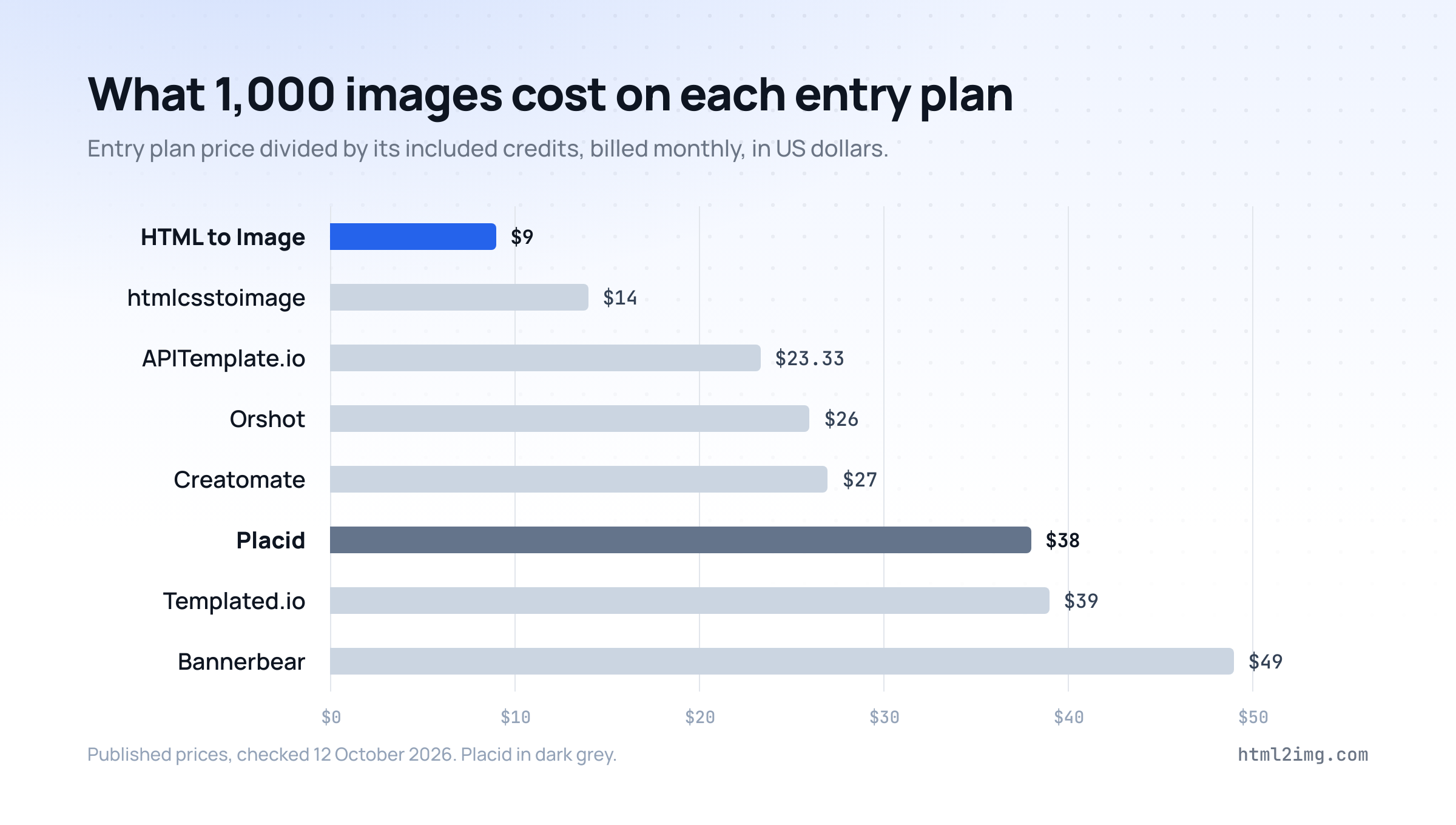
Tool | Entry plan, billed monthly | Per 1,000 images | Free option | Video | Renders your own HTML |
|---|---|---|---|---|---|
Placid | $19 / 500 credits | $38 | Trial credits, no card | Yes | No |
$9 / 1,000 credits | $9 | 50 credits, no card | No | Yes | |
Bannerbear | $49 / 1,000 credits | $49 | 30-credit trial | Yes | No |
Templated.io | $39 / 1,000 credits | $39 | 50 trial credits | Yes | No |
Orshot | $39 / 1,500 credits | $26 | 100 credits every month | Yes | No |
Creatomate | $54 / 2,000 credits | $27 | 50 trial credits | Yes | No |
APITemplate.io | $35 / 1,500 renders | $23.33 | 50 a month | No | PDFs only |
htmlcsstoimage | $14 / 1,000 images | $14 | 50 images a month | No | Yes |
Prices were checked against each vendor's published pricing on 12 October 2026. Most of them knock roughly two months off for annual billing.
Two columns do most of the sorting. Video narrows the field to the editor-first tools. The HTML column splits it the other way: Placid, like every editor-first product here, renders only templates built in its own editor, so a design that does not exist there cannot be generated. The code-first APIs take whatever markup you send them.
Why teams look past Placid
The credit maths is the first reason, and it bites hardest on the outputs Placid advertises most. A 60-second recap video costs 60 credits, so publishing one a week uses 240 credits a month, nearly half of the Basic allowance, before a single image is rendered. A five-page report costs ten. Upgrading helps, since Pro is $39 for 2,500 credits, but the exchange rate between images, video seconds and PDF pages stays the same at every tier.
The second is what the tiers hold back. Basic is a single-user plan, with team members and roles starting on Pro. Password protection and custom credit limits for Studio pages start on Business at $89. The Editor SDK, which is how you put Placid's editor inside your own product, is only on the $249 VIP plan, and white-labelling it is a conversation with sales.
The third is the rendering model. Placid renders its own templates and nothing else: there is no raw HTML endpoint and no URL screenshot. If your app already produces markup, or a page capture is part of the job, Placid means rebuilding the design in its editor or adding a second vendor.
None of this makes Placid a poor choice. It is the cheapest way on this list to buy 25,000 images a month, unused credits roll over up to double the monthly allowance, and every plan includes the URL API, the MCP server and the full set of no-code integrations. There is a section on when to stay near the end. The seven below are for the jobs that have outgrown that shape.
1. HTML to Image: when developers own the designs
HTML to Image is the code-first swap. Send your own HTML and CSS to one endpoint and get a PNG or PDF back, rendered in real Chrome with JavaScript, web fonts and emoji intact. For the standard shapes there are 25 named templates, from Open Graph cards to certificates and invoices, on every plan, so the Placid-style "send the data, get the design" call still exists without an editor in the loop.
Two differences matter most against Placid. A PDF render costs one credit, the same as a PNG, and long documents paginate inside that single render where Placid charges two credits a page. And URL screenshots run on the same key, which Placid does not offer at all.
The switch itself is small. A Placid render names a template by UUID, nests every value in a layers object and goes into a queue:
# Placid: queued by default, then poll or wait for a webhook
curl -X POST https://api.placid.app/api/rest/images \
  -H "Authorization: Bearer $PLACID_TOKEN" \
  -H "Content-Type: application/json" \
  -d '{
    "template_uuid": "ospo24ysn",
    "layers": {
      "title": { "text": "Placid alternatives, compared" },
      "subline": { "text": "Seven tools, priced" }
    }
  }'
Running this in production? Get an API key with 50 free credits, no card needed.
The HTML to Image call picks the template by slug in the URL, takes flat keys and returns the finished file's CDN url in the same response:
curl -X POST https://app.html2img.com/api/v1/templates/open-graph-image \
  -H "X-API-Key: $HTML2IMG_API_KEY" \
  -H "Content-Type: application/json" \
  -d '{
    "title": "Placid alternatives, compared",
    "subtitle": "Seven tools, priced"
  }'
When a design falls outside the templates, POST the markup to /api/html instead, which is the case Placid cannot cover. For renders that should not hold a request open, a webhook_url makes the API answer at once and post the result when it is ready.
Pricing starts at $9 a month for 1,000 credits, then $25 for 3,000 and $60 for 10,000, with no per-seat charges and an MCP server on every paid plan. Renders made on a paid plan are hosted on the CDN permanently.
Where it falls short: there is no visual editor and no video. There is no native Zapier app either, and the Make app is still in development, so no-code workflows call the API from an HTTP step, which is how the n8n image generation workflows are built. Volume is the other honest caveat. Placid's tiers jump from 2,500 credits to 25,000, so between 10,000 and 25,000 images a month its $89 Business plan beats our $120 for 30,000, and at 100,000 its $249 VIP plan beats our $300. The head-to-head with Placid works through the crossover.
2. Bannerbear: the bigger ecosystem, at a higher price
Bannerbear is the closest like-for-like swap for Placid in either direction, and the move to make when you want more of the same workflow rather than a smaller bill. The editor-first model is the same. Around it sits a broader surface: image, PDF and animation APIs, video tools, multi-step workflows, hosted forms, an MCP server and more than 50 app integrations.
You pay for the breadth. The Automate plan is $49 a month for 1,000 API credits, with a 30-credit trial, and team members, signed instant URLs and custom S3 storage arrive only on Scale at $149. Credits multiply, too: an image costs one credit per format and per scale, so a JPG and a PNG at 2x is four, and animations cost two credits a second. Pick it when the ecosystem is why you chose Placid and the budget can carry the difference. Our Bannerbear alternatives roundup covers the trip in the other direction.
3. Templated.io: a cheaper editor you can embed
Templated.io keeps the editor-first workflow at a similar entry price, and it answers Placid's most expensive gate. Its embeddable editor, white-label included, starts on the Scale plan at $99 a month, or $79 billed annually. Placid keeps its Editor SDK for the $249 VIP plan, so if you are putting a template editor in front of your own users, that gap is most of the decision.
Starter is $39 a month for 1,000 credits, or $29 billed annually. PDFs cost one credit a page against Placid's two, Canva designs import directly, and video is priced by resolution and length, at roughly 13 credits for ten seconds of 1080p at 30fps. The compromises are caps: 15 templates and two team members on Starter, 100 templates on Scale. Pick it for the Placid workflow with a cheaper embed and lighter PDF costs.
4. Orshot: a free tier that refills, and an embed on the first paid plan
Orshot has the most generous standing free plan on this list: 100 credits every month, rather than a trial that runs out. Templates come from its own editor, an official Figma plugin or a Canva import, and one credit buys an image, a PDF page or a second of video. Zapier, Make, n8n and an MCP server are among its integrations.
The first paid plan, Launch, is $39 a month for 1,500 credits with two team members and an embeddable editor, which carries Orshot branding until the $160 Grow plan removes it. That puts an embedded editor well below Placid's VIP tier. The weak point is the price per credit at the bottom: $39 buys 1,500 credits here and 2,500 on Placid Pro. Pick it when a free tier you can leave running matters, or when you need an embed without a $249 plan.
5. Creatomate: when video is the real job
If most of your Placid credits go on video, Creatomate is the specialist. It is a video-first engine built around a timeline, with animation on any element, transitions between scenes, audio tracks and automatic subtitles, driven through a JSON-based API or through Zapier, Make and n8n.
Its credit maths favours video as well. An image is always one credit, and video is priced by pixels rendered, at one credit per 100 million: ten seconds of 1080p at 30fps comes to about six credits where Placid charges ten, and a minute of 720p at 25fps is about 14 credits against Placid's 60. Essential is $54 a month for 2,000 credits, or $45 billed annually, with 50 trial credits. Two things to plan around: the embeddable preview SDK starts on Growth at $129, and renders are deleted after 30 days, so your pipeline has to copy every file somewhere permanent. Pick it when video is the product.
6. APITemplate.io: when PDFs are the real job
APITemplate.io is the shortlist entry for teams whose output is mostly documents. It sells separate PDF-only plans and builds PDF templates in either a visual editor or an HTML editor, so documents can come straight from markup even though images still go through its image template editor.
The PDF-only Basic plan is $24 a month for 3,000 PDFs, or $19 billed annually, which undercuts Placid sharply for document work, where one three-page PDF costs six credits. The combined image and PDF Starter plan is $35 a month for 1,500 renders with 15 templates, and a standing free plan gives you 50 renders a month with three templates. Teams arrive on Standard at $89 a month. Pick it for invoices, statements and reports in volume; for image work alone the pricing is middling.
7. htmlcsstoimage: the minimal raw-HTML API
htmlcsstoimage is the longest-running code-first option and the other raw-HTML route on this list. You send markup and get an image back. URL screenshots, Zapier and Make connections and an MCP server come on every plan, stored templates from Basic upwards, and there are no per-seat charges.
Basic is $14 a month for 1,000 images, and the free tier covers 50 a month, though free renders are not kept indefinitely and PDF generation starts on Basic. Fonts come from Google Fonts. It is the closest like-for-like for HTML to Image, which is why there is a parameter-by-parameter migration guide for moving between the two. Pick it if you want the raw HTML model from the longest-running provider on this list.
What about Robolly, DynaPictures and Abyssale?
They turn up on Placid shortlists too. Robolly and DynaPictures are editor-first tools built around render links and spreadsheet batches, and both are covered in the Bannerbear roundup. Abyssale prices per seat, from $36 a seat a month on annual billing, which makes it a tool for an ad-design team rather than an API you meter by the render.
When Placid is still the right call
Stay if three things are true: a marketer owns the designs, your volume runs into the tens of thousands, and your outputs mix images with video and documents. At 25,000 images a month, the Business plan's $89 beats every other tool here. Rollover absorbs uneven months, the URL API and MCP server come with every plan, and Studio forms let colleagues generate visuals without touching an automation. For that team it is a well-made product, and switching would cost more than it saves.
How to pick from the seven
Three questions settle it.
Who designs the templates? A marketer in a canvas points to the editor-first tools: Bannerbear for the broadest ecosystem, Templated.io or Orshot for a cheaper editor you can embed. A developer in code points to HTML to Image or htmlcsstoimage, and your templates live in your repository instead of someone else's editor.
What do you actually render? Video points to Creatomate, or to Bannerbear and Templated.io for lighter clips. Paginated documents point to APITemplate.io, or to HTML to Image when the PDFs sit next to images on one key. Page captures rule out every editor-first tool on the list.
What does your real month cost? Price your mix rather than the entry plan, and count PDF pages and video seconds separately, because those are where Placid's credits go fastest. The framework in how to choose an HTML to image API covers the production details that only surface after the trial.
Rendering OG images, certificates or invoices from your own HTML, with a PDF costing the same single credit as a PNG? Browse the templates gallery or read the docs to get started.

Written by
Mike Griffiths
Mike has spent the last 20 years crafting software solutions for all kinds of amazing businesses. He specializes in building digital products and APIs that make a real difference. As an expert in Laravel and a voting member on the PHP language, Mike helps shape the future of web development.