Bannerbear Alternatives: 7 Image Generation APIs Compared (2026)
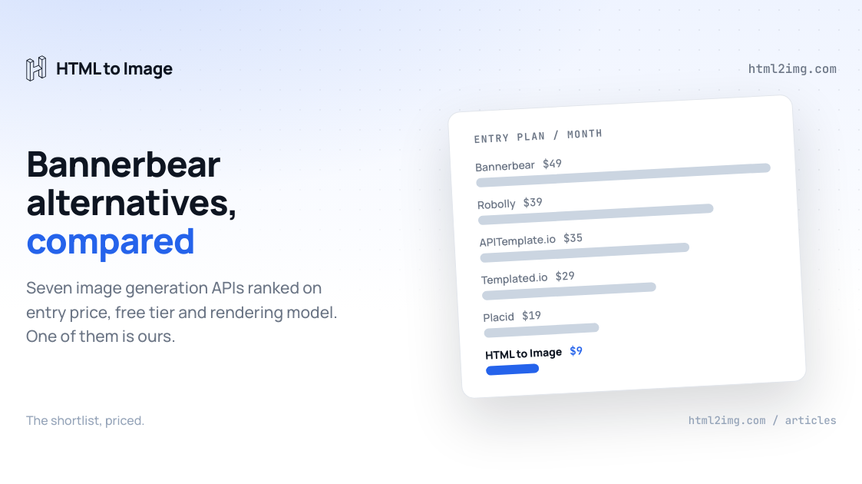
Bannerbear made automated image generation a mainstream idea: design a template in a visual editor, push data at an API, get a branded PNG back. It is a good product with a real ecosystem, and it costs $49 a month for 1,000 credits at the entry tier. That price, and the requirement that every design exists as an editor template first, is why "Bannerbear alternatives" is a search people run.
This is that comparison, done properly. Seven services that generate images from data, ranked with their real entry prices, free tiers and rendering models, and an honest note on who each one actually suits.
*Disclosure: we built HTML to Image, and it is first on this list. We have kept the comparison honest because the alternative is search results full of low-effort listicles.*
The quick comparison
Tool | Entry plan | Free tier | Renders your own HTML |
|---|---|---|---|
Bannerbear | $49 / 1,000 credits | 30-credit trial | No |
$9 / 1,000 credits | 50 renders, no card | Yes | |
htmlcsstoimage | $14 / 1,000 images | 50 images a month | Yes |
Placid | $19 / 500 credits | Trial credits | No |
Templated.io | $29 / 1,000 (annual billing) | 50 one-time credits | No |
DynaPictures | $29 / 250 images | 30-credit trial | No |
APITemplate.io | $29 / 1,500 (annual billing) | 50 a month | PDFs only |
Robolly | $39 / 250 to 1,000 renders | 7-day trial | No |
Entry prices re-checked against each vendor's published pricing in August 2026.
The "renders your own HTML" column is the structural split in this market. Editor-first tools (Bannerbear, Placid, Templated.io, Robolly, DynaPictures) render only templates built in their editor, which is exactly right when a marketer owns the designs and exactly wrong when your app already produces HTML. Code-first tools take whatever markup you send.
Why teams look past Bannerbear
Three reasons come up repeatedly. The first is price: $49 a month is the cost of entry, and PDF renders burn three credits each, so a modest invoice workflow gets expensive quickly. The second is the editor-only rendering model: if a design does not exist as a Bannerbear template, it either gets rebuilt in the editor or stays out of the workflow, and there is no raw HTML endpoint for the cases that do not fit. The third is scope: Bannerbear does not do URL screenshots, so page captures mean a second vendor.
None of that makes it a bad product. If a non-technical team member designs and maintains the templates, the visual editor is the product and you should probably stay. This list is for everyone else.
1. HTML to Image: raw HTML and named templates from $9
HTML to Image is the code-first option: send your own HTML and CSS to one endpoint and get a PNG or PDF back, rendered in real Chrome with full JavaScript execution. For the standard shapes, 25 named templates (Open Graph images, invoices, certificates, code screenshots, social cards) are available on every plan, including the free one, so you can skip the markup entirely when a stock design fits.
The entry plan is $9 a month for 1,000 credits against Bannerbear's $49 for the same volume, a PDF costs the same single credit as a PNG, and URL screenshots ride on the same key. There are no per-seat charges and no template caps. The free tier is 50 renders with no card.
Where it falls short: there is no visual editor. If your marketing team wants to drag a headline around a canvas, this is the wrong tool and the head-to-head with Bannerbear says so. Pick it when developers own the pipeline and the design lives in code.
2. Placid: the closest editor-for-editor swap
Placid is the most direct like-for-like substitute if what you value in Bannerbear is the workflow rather than the invoice. Marketers design in a drag-and-drop editor, then feed data through Zapier, Make, Airtable, WordPress or the REST API. One credit pool covers images, video and PDFs, which Bannerbear cannot match on a single plan.
Entry pricing is $19 a month for 500 credits, so the per-image cost is close to Bannerbear's; the saving is at the entry point, not at volume. Like Bannerbear, it renders only its own editor-built templates: no raw HTML, no URL screenshots. Pick it when a non-technical team owns the designs and your automation spans video as well as images.
3. Templated.io: Canva-style editing at a lower entry price
Templated.io undercuts Bannerbear at $29 a month for 1,000 credits, with the catch that the headline price is on annual billing. The editor is the draw: Canva import, an embeddable white-label editor you can put in front of your own users, and MP4 and PDF output from the same credit pool.
The compromises are caps. Templates are counted per plan (15 on Starter), and team members are gated by tier, so the effective price climbs with the team. Rendering is editor-templates only. Pick it when you want the Bannerbear workflow, cheaper, and can live inside the caps.
4. APITemplate.io: the PDF-heavy choice
APITemplate.io is the one to shortlist when documents matter as much as images. Its PDFs carry headers, footers, page numbering and page-size control, which none of the image-first tools on this list match, and it accepts raw HTML for PDF generation. Four regional endpoints help with latency and data residency.
Entry pricing is $29 a month for 1,500 images or PDFs on annual billing, $35 billed monthly, with a genuinely useful free tier of 50 renders a month and 3 templates. The image pipeline still runs through managed templates built in its editors, and there are no URL screenshots. Pick it for report-style documents with running heads; for image work alone the pricing is middling.
Coming at this list from the other direction and hunting for an APITemplate.io alternative? The raw HTML tools at the top and bottom of this page are the usual landing spots, and the APITemplate.io comparison walks the switch through feature by feature.
5. Robolly: render links for no-code automations
Robolly's signature is the render link: template parameters in a GET query string, HMAC-signed so links stay safe in public, cached so repeat renders do not touch quota. That model slots neatly into Zapier, Make, Pabbly and Google Sheets, and video add-ons cover short personalised clips.
The economics are the weak point. The Individual plan is $39 a month for between 250 and 1,000 renders depending on complexity, the free option is a 7-day trial rather than a standing tier, and webhook delivery is not surfaced. Pick it when image generation lives inside no-code automations and render links are the shape you want; skip it when a developer is doing the integrating.
6. DynaPictures: spreadsheet-driven personalisation
DynaPictures is built for a marketer producing hundreds of personalised banners without a developer: unlimited editor templates, spreadsheet imports, online forms, plus design conveniences like face detection and automatic text resizing.
The per-image cost is the highest here: from $29 a month for 250 images on Lite, which also carries a single user seat. There is no raw HTML rendering and no screenshot capability. Pick it when batch personalisation from a spreadsheet is the actual job; at developer-driven volume the economics do not work.
7. htmlcsstoimage: the minimal raw-HTML API
htmlcsstoimage has been the default code-first answer since 2018: send HTML and CSS, get an image, with URL screenshots and JavaScript execution included and a Templates API for stored designs. It is a known quantity with years of production mileage.
Entry pricing is $14 a month for 1,000 images with a standing free tier of 50 a month. The gaps are at the edges: fonts are Google Fonts only, and there is no webhook delivery for async flows. It is the closest competitor to HTML to Image, which is why there is a parameter-by-parameter migration guide for moving between the two. Pick it if you want the raw HTML model from the longest-running provider and the price gap does not bother you.
What about Urlbox and the screenshot APIs?
Searches for Bannerbear alternatives often surface Urlbox, ScreenshotOne and ApiFlash. They solve a different problem: capturing existing web pages from a URL, not generating designed images from data. If your job is page captures, they belong on a different shortlist. If your job is branded images from templates or markup, they do not replace anything on this page, although the code-first tools above handle URL screenshots as a side capability.
How to pick from the seven
Three questions settle it. Who builds the designs: if it is a marketer in a canvas, choose Placid, Templated.io or DynaPictures; if it is a developer in code, choose HTML to Image or htmlcsstoimage. What are the outputs: video points at Placid or Templated.io, paginated PDFs at APITemplate.io, mixed PNG and single-page PDF at the code-first tools. And what does your volume cost: multiply your monthly render count across the table above, because the gap between $9 and $49 per thousand compounds quickly. There is a longer framework in how to choose an HTML to image API, including the cases where you do not need a paid service at all.
Rendering OG images, invoices or certificates from your own HTML, without a template editor in the way? Browse the templates gallery or read the docs to get started.

Written by
Mike Griffiths
Mike has spent the last 20 years crafting software solutions for all kinds of amazing businesses. He specializes in building digital products and APIs that make a real difference. As an expert in Laravel and a voting member on the PHP language, Mike helps shape the future of web development.